Rounexes vs Tuni Coffee Grinders: Which Brand Fits You?
As an Amazon Associate we earn from qualifying purchases. Links on this page are affiliate links.
When comparing rounexes vs tuni coffee grinder options, you face a choice between flat and conical burr designs. Both brands offer electric grinders with adjustable grind settings for various brew methods. The Rounexes model features a flat burr mechanism with 17 settings, while the Tuni G1 uses a conical burr with 48 settings. Each unit includes a portafilter holder for direct grinding. You must decide which burr type and capacity best fits your daily brewing routine.
Key differences
| Aspect | Rounexes Compact Flat Burr Grinder | Tuni 40mm Conical Burr Grinder |
|---|---|---|
| Grinding Mechanism | Flat burr | Conical burr |
| Grind Settings | 17 settings | 48 settings |
| Bean Capacity | 7 oz | 8.8 oz |
| Burr Size | not listed | 40 mm |
| Weight | 2.5 pounds | 4.8 pounds |
Which one should you choose?
Choose Rounexes Compact Flat Burr Grinder if
- You prefer a lighter, more compact unit for small spaces.
- You want a flat burr design for consistent particle size.
- You need a grinder with a simpler control interface.
Choose Tuni 40mm Conical Burr Grinder if
- You require finer control over grind size with 48 settings.
- You want a larger bean hopper capacity for batch brewing.
- You prefer a conical burr system with low heat buildup.
Verdict: Choose the Rounexes if you prioritize a lighter footprint and a flat burr mechanism. Select the Tuni if you need more precise grind adjustments and a larger bean capacity. Both models support direct portafilter grinding for espresso preparation.
Rounexes vs Tuni Grinder Specs
Grinding Mechanism
The Rounexes Compact Flat Burr Grinder uses a flat burr design with hardened stainless steel burrs. This setup is marketed for consistent particle size, which supports optimal extraction for various brew styles. In contrast, the Tuni G1 features a patented 40mm conical burr system. Conical burrs typically operate at lower speeds, with the Tuni running at 450 RPM to minimize heat buildup and static. This lower speed helps maintain stable bean temperature during grinding. Flat burrs often spin faster and may generate more heat, though the Rounexes includes anti-static technology. The choice between flat and conical depends on your preference for heat management and grind consistency profiles.
Grind Settings
Adjustability is a key factor for versatility. The Rounexes model offers 17 precise grind settings, ranging from espresso-fine to French press-coarse. This range covers most common home brewing methods. The Tuni G1 provides 48 adjustable settings, offering significantly more granularity. You can fine-tune the grind size in smaller increments, allowing for more precise dialing in for specific beans or espresso recipes. The Tuni also allows grind time adjustments in 0.5-second increments up to 40 seconds. If you need fine control over particle size distribution, the Tuni’s higher number of settings gives you more options to experiment with.
Bean Capacity
Hopper size affects how often you need to refill beans. The Rounexes grinder has a 150 g sealed hopper, which holds approximately 5.3 oz of coffee beans. This capacity is suitable for smaller households or those who prefer grinding fresh for each session. The Tuni G1 features a larger 250 g hopper, holding about 8.8 oz. This larger capacity allows you to grind more beans at once, reducing the frequency of refills. Both hoppers are designed for freshness, with the Rounexes being tool-free removable for cleaning. If you brew larger batches or have multiple cups to prepare, the Tuni’s extra capacity is more convenient.
Portafilter Compatibility
For espresso users, direct grinding into a portafilter is a useful feature. The Rounexes grinder includes an adjustable cradle that fits portafilters with diameters between 51–58 mm. This range covers most standard home espresso machines. The Tuni G1 comes with a detachable portafilter holder compatible with 54–58 mm portafilters. Both grinders support direct grinding, which minimizes grounds loss and mess. The Rounexes cradle starts at 51 mm, potentially accommodating slightly smaller portafilters, while the Tuni starts at 54 mm. Both are suitable for standard 58 mm commercial-style baskets. If you use non-standard smaller portafilters, the Rounexes offers a slight advantage in range.
Dimensions and Weight
Space and stability matter for kitchen counters. The Rounexes grinder measures 6.9 inches in length, 4.61 inches in width, and 12.8 inches in height, weighing 2.5 pounds. Its compact footprint makes it easy to store in small spaces. The Tuni G1 is taller at 14 inches, with a width of 4.52 inches and a length of 7.08 inches, weighing 4.8 pounds. The Tuni is significantly heavier, which may provide better stability during operation but takes up more vertical space. The Rounexes is lighter and shorter, making it easier to move or store. If counter space is limited, the Rounexes is more compact.
Which grinder fits your brew style
Espresso users needing direct portafilter grinding
The Rounexes grinder includes an adjustable 51–58 mm portafilter cradle. This allows you to grind directly into most standard portafilters. The flat burr design targets consistent particle size for optimal extraction. You get 17 precise settings to dial in your shot. This direct grinding path saves time and reduces static mess during your morning routine.
Brewers wanting high grind precision and capacity
The Tuni G1 offers 48 grind settings for fine-tuning consistency. Its 40 mm conical burrs run at 450 RPM to minimize heat buildup. You also get a larger 250 g bean hopper for longer brewing sessions. The 0.5-second time increments let you adjust grind duration precisely. This setup suits those who want detailed control over their coffee strength and flavor profile.
Users prioritizing easy cleaning and maintenance
The Rounexes model features fully removable parts that are top-rack dishwasher safe. You can quickly swap beans with the tool-free removable hopper. Anti-static technology helps reduce mess during grinding. The included cleaning brush and removable grounds bin make upkeep simple. This design ensures you can maintain hygiene and flavor clarity with minimal effort after each use.
The products compared
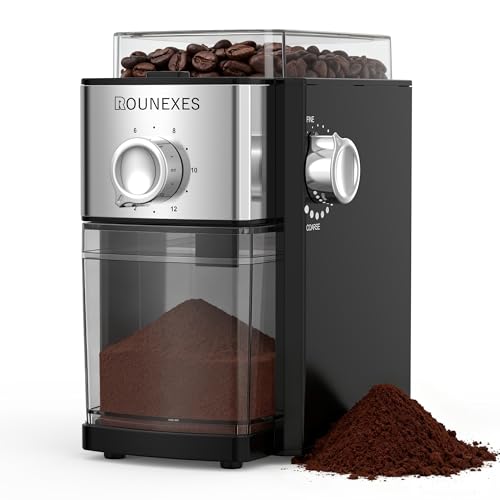
Rounexes Compact Flat Burr Grinder
Best for: compact kitchens and espresso users
- Grinding Mechanism
- Flat burr, conical burr
- Burr Material
- Hardened stainless steel
- Grind Settings
- 17, 30
- Bean Capacity
- 150 g (5.3 oz), 300 g / 10 oz
- Power Source
- Electric
- Brew Method
- Espresso, Cold Brew
View on Amazon: Rounexes Compact Flat Burr Grinder Affiliate link
The Rounexes BG709 uses flat stainless steel burrs for consistent particle size. It offers 17 grind settings, covering espresso to French press. The unit holds 7 ounces of beans and doses for 2–12 cups. Its compact dimensions and removable parts make it suitable for small kitchens. You get straightforward button controls and a portafilter cradle for direct grinding.
Pros
- Flat stainless steel burrs for uniform grinding
- 17 precise grind settings for various brews
- Removable, dishwasher-safe burr assembly and hopper
- Adjustable portafilter cradle for espresso machines
- Compact footprint for limited counter space
Cons
- Only 17 grind settings compared to 48 on the Tuni G1
- Smaller 7-ounce bean hopper capacity
- No programmable timer or digital display
Good fit if
- You want a compact grinder for espresso and drip coffee
- You prefer manual button controls over digital interfaces
- You need easy cleaning with dishwasher-safe parts
Skip if
- You require high-volume grinding for large households
- You need fine-tuned adjustments with many grind steps
- You want automatic dosing or timer features
Verdict: Rounexes BG709 Flat Burr Grinder fits users who prioritize compact size and easy cleaning over high-volume capacity or extensive grind precision.

Tuni 40mm Conical Burr Grinder
Best for: Compact kitchens and espresso preparation
- Grinding Mechanism
- Conical burr
- Burr Size
- 40mm
- Burr Material
- Stainless steel
- Grind Settings
- 48 settings
- Bean Capacity
- 250g / 8.8oz
- Power Source
- Electric motor
View on Amazon: Tuni 40mm Conical Burr Grinder Affiliate link
The Tuni G1 is a compact electric burr grinder featuring a 40mm conical burr and 48 grind settings. It operates at a low 450 RPM to reduce heat and static. The unit includes a 250g bean hopper and adjustable grind time from 0.5 to 40 seconds. Its small footprint fits tight counters while offering portafilter compatibility for espresso or drip brewing.
Pros
- 48 precise grind settings from espresso to french press
- Low 450 RPM speed minimizes heat and static buildup
- Compact 7.08-inch width with a 250g bean hopper
- Includes detachable holder for 54-58mm portafilters
- Adjustable grind time in 0.5-second increments up to 40 seconds
Cons
- Smaller 40mm burr size compared to flat burr competitors
- 250g bean hopper capacity limits bulk brewing sessions
- Heavier 4.8-pound build for its compact dimensions
Good fit if
- You need a compact grinder for a small kitchen counter
- You want precise control over grind time for consistency
- You brew espresso and need a portafilter holder
Skip if
- You prefer flat burr grinders for maximum uniformity
- You need a large bean hopper for high-volume brewing
- You want a lighter, more portable unit
Verdict: The Tuni G1 Conical Burr Grinder offers precise, low-heat grinding in a compact footprint. It fits users who prioritize consistent dosing and portafilter compatibility in a small space.
Specifications side by side
| Spec | Rounexes Compact Flat Burr Grinder | Tuni 40mm Conical Burr Grinder |
|---|---|---|
| Grinding Mechanism | Flat burr, conical burr | Conical burr |
| Burr Size | not stated | 40mm |
| Burr Material | Hardened stainless steel | Stainless steel |
| Grind Settings | 17, 30 | 48 settings |
| Bean Capacity | 150 g (5.3 oz), 300 g / 10 oz | 250g / 8.8oz |
| Power Source | Electric | Electric motor |
| Dosing Control | not stated | Digital timer |
| Grinder Type | Burr, Flat Burr | Burr, Conical Burr |
| Brew Method | Espresso, Cold Brew | Espresso, French Press, Drip Coffee, Cold Brew |
| Size | Small | G1-W |
| Base Type | Flat Base | not stated |
| Features | not stated | Timer |
| Material | not stated | Stainless Steel |
| Dimensions | 7.5 × 5.46 × 8.24 inches | 7.09 × 4.53 × 10.1 inches |
| Weight | 2.5 pounds | 4.8 pounds |
| Color | silver black | Ivory |
| Model | BG701 | G1-W |
Frequently asked questions
Which grinder is better for espresso?
The Rounexes model includes a portafilter cradle adjustable from 51 to 58 mm. This allows you to grind directly into standard portafilters. The Tuni G1 also targets espresso preparation with its conical burr design. Both brands suit users who prioritize compact size for their brewing needs.
What is the size difference between the two?
The Rounexes grinder measures 4.61 inches wide and 12.8 inches tall. It weighs 2.5 pounds. The Tuni G1 weighs 4.8 pounds. While specific dimensions for the Tuni are not listed, the Rounexes model is explicitly categorized as small and compact for tight kitchen spaces.
Does the Tuni grinder have adjustable settings?
Yes, the Tuni G1 Conical Burr Grinder offers 48 grind settings. This range allows you to adjust particle size for various brew methods. The Rounexes model also features adjustable settings, though the exact count is not specified in the provided data for this comparison.
Are these grinders electric?
Both the Rounexes Compact Flat Burr Grinder and the Tuni G1 are electric-powered devices. You do not need to manually turn the burrs. This power source supports consistent grinding speeds, which helps maintain burr alignment and reduces heat buildup during use for both brands.
Which one is lighter to move?
The Rounexes BG709 weighs 2.5 pounds. The Tuni G1 weighs 4.8 pounds. If you frequently move your grinder, the Rounexes option is significantly lighter. Its compact flat base also provides stability without adding extra weight to your countertop space.
Can I use these for cold brew?
The Rounexes grinder lists cold brew as a supported brew method. Its flat burr design targets consistent particle size suitable for longer extraction times. The Tuni G1 focuses on espresso and compact kitchen use. You should verify if the Tuni explicitly supports coarse grinds for cold brew.